

Wondering what the Canadian Dental Care Plan (CDCP) actually covers in 2026—and how much you’ll really pay?
This quick guide breaks down covered services, eligibility, and real costs, so you can understand exactly how the CDCP works before booking your dental visit.
What Is the Canadian Dental Care Plan (CDCP)?
The Canadian Dental Care Plan (CDCP) is a federally funded dental benefit designed to help eligible Canadians access essential oral health care.
Unlike free public healthcare, the CDCP works as an insurance-style program:
- It pays part of your dental costs
- Uses a federal fee schedule (not Ontario fees)
- May still leave you with out-of-pocket costs

Who Is Eligible for CDCP in 2026?
To qualify, you must meet all four conditions:
1. Income Requirement
- Household income must be under $90,000
- Based on your CRA tax return
2. No Dental Insurance Access
You are not eligible if you have access to:
- Employer dental benefits
- Pension plans
- Student or association coverage
Even if you don’t use it, access = ineligible
3. Canadian Residency
- Must be a Canadian resident for tax purposes
- Must have filed your latest taxes
4. Age Groups (Now Fully Expanded)
- Children (0–17)
- Adults (18–64)
- Seniors (65+)
How to Apply for the CDCP
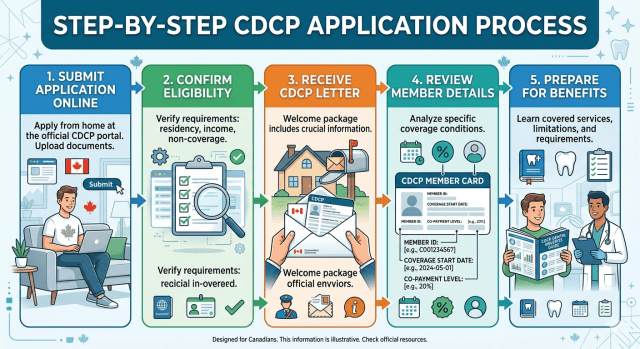
Applying for the cdcp application process is a straightforward process designed to ensure that Canadians can quickly access the dental benefits they need. The process includes:
- Submitting applications online, allowing clients to apply from the comfort of their homes.
- Confirming eligibility.
- Receiving a letter detailing their CDCP member ID, coverage start date, and co-payment level.
To maximize the benefits available under the CDCP, clients are encouraged to review the CDCP Dental Benefits Guide and familiarize themselves with the specific services covered under the plan. This preparation is essential in navigating the nuances of the CDCP and ensuring that all necessary documentation is submitted accurately and on time.
What Dental Services Are Covered?
The CDCP focuses on essential and preventive care, not cosmetic treatments.
Covered Services Include:
- Dental exams (routine & emergency)
- X-rays (with limits)
- Cleanings (scaling)
- Fillings
- Root canals
- Tooth extractions
- Dentures (with approval)
- Nitrous oxide (sedation)
- Emergency pain treatment
Not Covered:
Preventive Care: What You Can Expect
Preventive services are a major part of CDCP and help avoid bigger dental problems.
These typically include:
- Regular checkups (usually once per year)
- Cleanings (limited units per year)
- Fluoride treatments (for children)
- Sealants (for kids)
These limits are important—extra services may require approval.
CDCP Costs in 2026 (Important Update)
The biggest misunderstanding:
CDCP does NOT mean free dental care
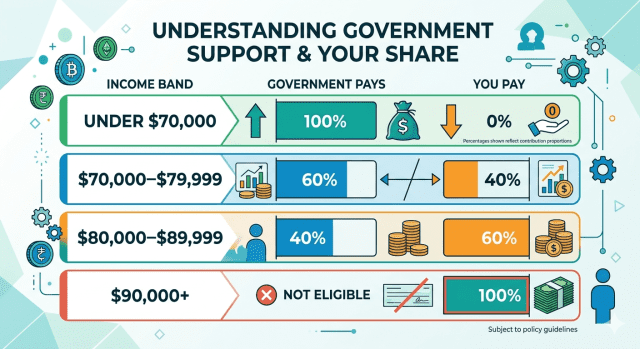
Income-Based Co-Payment
What Is Balance Billing? (Why You Still Pay)
Even if you qualify, you may still pay extra.
Reason: CDCP fees are lower than Ontario dental fees
Example:
- Dentist fee: ~$160
- CDCP fee: ~$80
- Government pays (60%): ~$48
You pay:
- Co-pay: ~$32
- Balance billing: ~$80
Total: ~$112 out-of-pocket

Frequency Limits & Pre-Authorization
Some services are limited or require approval:
- Cleanings: limited yearly units
- Exams: typically once per year
- X-rays: restricted frequency
- Crowns & dentures: pre-approval required
Always confirm before treatment to avoid surprises.
Orthodontics (Braces) in 2026
- Not covered for routine cases
- May be approved only for severe medical conditions
- Cosmetic orthodontics = not included
Important: Annual Renewal
CDCP is not permanent coverage
To keep your benefits:
- File your taxes every year
- Renew before June 1
- Coverage runs: July → June
Missing renewal = coverage stops
CDCP vs Private Insurance
CDCP helps—but it’s not equal to private insurance.
CDCP:
- Lower fee coverage
- Income-based co-pay
- Possible balance billing
Private Insurance:
- Higher coverage rates
- More procedures included
- Less out-of-pocket cost
Good news: You can coordinate benefits if eligible.

Common CDCP Mistakes to Avoid
❌ “It’s free dental care”
✔️ It’s partial coverage
❌ “100% coverage means no cost”
✔️ Balance billing still applies
❌ “I’ll cancel my insurance to qualify”
✔️ That makes you ineligible
The Canadian Dental Care Plan (CDCP) is a major step toward making dental care more accessible in Canada.
But in 2026, success with CDCP comes down to understanding:
- It’s insurance, not free care
- Fees vary by clinic
- You may still pay out-of-pocket
- Annual renewal is required
When used correctly, CDCP can significantly reduce your dental costs and help you maintain long-term oral health.
Frequently Asked Questions
1.Is the Canadian Dental Care Plan (CDCP) completely free?
No, the CDCP is not completely free, even in 2026. It is a government-funded dental benefit that covers a portion of your dental care costs based on your household income.
If your family income is under $70,000, the plan may cover 100% of the CDCP fee schedule, meaning you won’t have a co-payment. However, many dental clinics charge higher fees than the CDCP rate, which means you may still need to pay the difference—this is called balance billing.
In simple terms:
The CDCP reduces your costs significantly, but it does not always eliminate them entirely.
2. Who qualifies for the CDCP in 2026?
To be eligible for the CDCP in 2026, you must meet all of the following criteria:
- Be a Canadian resident for tax purposes
- Have filed your most recent tax return
- Have a household income under $90,000
- Have no access to any dental insurance (including employer or pension plans)
One important detail is that having access to insurance makes you ineligible, even if you choose not to use it.
As of 2026, the program is fully expanded and available to children, adults, and seniors, as long as all eligibility conditions are met.
3. What dental services does the CDCP cover?
The CDCP covers a wide range of essential and preventive dental services to help maintain oral health and treat common dental issues.
Covered services typically include:
- Dental exams (routine and emergency)
- X-rays (with limitations)
- Cleanings (scaling and polishing)
- Fillings
- Root canals
- Tooth extractions
- Dentures (with approval)
- Sedation (such as nitrous oxide)
However, the plan focuses on medically necessary treatments, not cosmetic procedures.
4. Why do some patients still pay out-of-pocket with CDCP?
Even with CDCP coverage, patients may still have to pay out-of-pocket due to two main factors:
1. Income-based co-payments
If your household income is above $70,000, you are required to pay a percentage (40% or 60%) of the CDCP-approved fee.
2. Balance billing
The CDCP uses a federal fee schedule that is often lower than what dental clinics charge. If your dentist’s fees are higher, you are responsible for paying the difference.
This means your final cost depends on both your income level and your dental provider’s pricing.
5. Do I need to renew my CDCP coverage every year?
Yes, CDCP coverage must be renewed annually to remain active.
To renew your coverage, you must:
- File your taxes each year
- Meet the eligibility requirements again
- Complete renewal before the deadline (typically June 1)
Coverage periods usually run from July 1 to June 30 of the following year. If you miss the renewal deadline, your coverage may be interrupted, and you could temporarily lose access to benefits.
Keeping your information up to date ensures continuous dental coverage without gaps.


